
an ode to Marquay James: the wretched of the earth
Marquay James was born 10.27.2001. He was the pinnacle of modern revolutionary Pan-Africanism, a true poor righteous teacher, and he was found on 3.27.2026 to have become an ancestor near Denver, Colorado.
“My allegiance falls to the Black community, not how many followers I have”
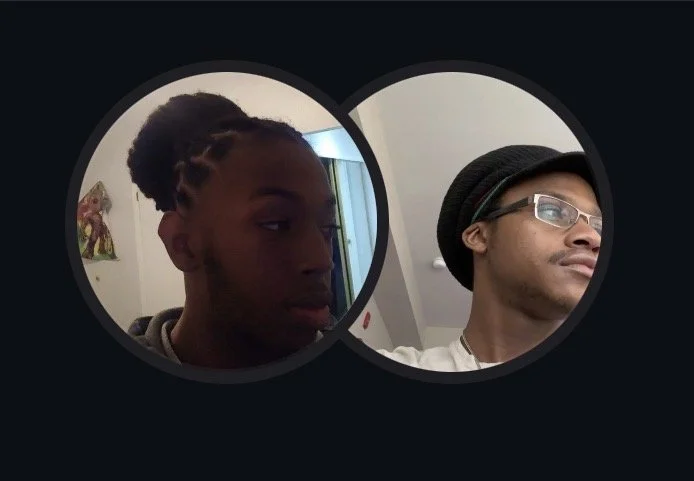
Marquay’s and my profile pictures from Instagram.
I had a front row seat to the early development of Marquay’s Pan-African ideology when we met in late 2020. We met online when I was 16 and he was 18, as chapter presidents of the Young Black Panther Party, a mostly online and ideologically inconsistent effort at responding to the colonial conditions of the early 2020s.
We connected over our mutual recognition of the organizations political inconsistencies, from a leader who espoused conspiracy theories to members who applied classically liberal strategies to radical organizing.
“Yeah and I think that’s the difference between people — some black activists — and you and I. We are looking for independence, not necessarily equality — we’re not looking to have a seat at the table with the white man”
Driven by state-mandated quarantine lockdowns, Marquay and I spent countless hours on end between late 2020 and early 2022 examining the lessons that lay within the history of our people over voice notes and phone calls. We would research and bring our study back to each other, like show and tell, every night.
He was the first friendship I ever built, based in anti-colonial Pan-Africanism, and he fundamentally shaped the way I view and understand life today. We often spoke about how it felt like we were the only ones who understood each other.
As I prepared to attend college at Morgan State University in Baltimore, Marquay pushed me to politicize and organize around that environment. We studied Black college organizing and he would check in to ask about my perspective of the political landscape of the Black university — we were both disappointed when we realized how far it fell short of our high expectations.
He was my best friend, my comrade, my brother. And like all those who came before us, we will meet again in the hereafter.
Marquay’s mother, Kendra James, was 21-years old when she was murdered by an Oregon police officer, in the only state founded explicitly as a whites-only utopia by white supremacists, per its constitution.
She was 19 when she birthed him in hell, at the epicenter of the clashing historical forces of African oppression. Part of those clashing historical forces were brought about by her own identity as a Black woman and single mother in the colonial core.
The brutality of those forces left him with scars like health complications which affected his breathing and caused him to have seizures.
Before colonialism, Africans who had seizures — like Marquay — were understood by other Africans to be ancestrally delivered for mediation between the spirit world and the physical realm, according to Lovette Jallow. Their “disabilities” and “scars” were seen as gifts and relics of memory.
Their input led and dictated African societies.
On the plantation, Africans with seizures resisted their reality and were understood by other Africans as prophets, deities, and leaders of movements, if they were not killed or institutionalized by colonialism. When Africans with seizures survived by the guide of their ancestors, they became the Harriet Tubmans and they led and dictated African society.
Since slavery in America, colonialism has created a multi-dimensional hell on earth for Africans with disabilities. Those who have lived and resisted that hell became our El Hajj Malik Shabazz’s (Malcolm Xs), our Frantz Fanons, and our Assata Shakurs. All whose disabilities, either born with or imposed upon by colonialism, shaped their resistance to hell.
“Confronted with a world configured by the colonizer, the colonized subject is always presumed guilty. The colonized does not accept his guilt, but rather considers it a kind of curse, a sword of Damocles. But deep down the colonized subject acknowledges no authority”
Marquay was the one from our generation who resisted that reality. He stood as a revolutionary against the system of colonialism set out to destroy the African. The system that most of us bow to.
He was the son of a martyr, he was isolated from his family, funneled with his younger brother into Colorado’s majority-white foster care system, and left to find his voice for his and his brother’s survival.
Marquay told me, that in 8th grade, he started studying the mistakes and lessons of the Haitian Revolution and that he was inspired by Toussaint L’Overture. The movement helped him re-member who he and his people were, African.
Since I met him in late 2020, he struggled with the conditions imposed on him by colonialism, unemployment, housing insecurity, social alienation, and frequent hospital visits which he endured alone. During his struggle with the greatest oppressor in the world, he would still make time to ask me what I was doing politically for African people in Baltimore.
Africa was always at the center of Marquay’s analysis.
He represented the inseparability of the African reality in America from the global African reality. A reality marked by a diametric opposition to colonialism. His reality would never allow him to be at peace with being American or a member of colonialism.
He saw himself in the Africans of the DRC, of Haiti, and of America because he wore the scars of the collective African people. He refused to allow colonialism make him forget who he was. And he grounded his experience in the unity of African people’s collective oppressed experiences.
Because like Marquay, oppressed Africans across the world wear the scars of Africa and cannot be made to forget it. Their scars shape African reality, tell African history, and carry African memories. The more scars there are, the closer we find ourselves to home in the colonial and neocolonial era.
“Colonialism is not satisfied with snaring the people in its net, or of draining the colonized brain of any form or substance. With a kind of perverted logic, it turns its attention to the past of the colonized people and distorts it, disfigures it, and destroys it”
Colonialism seeks to distort, disfigure, and dismember our past to make us forget the scars — or the lessons — taught by our history. By making us forget the scars and lessons taught by our history, we forget the violence and brutality of colonialism against our people both historically and presently.
But revolutionary Africans like Marquay worked to make us “re-member” Africa. The scars they wear tell the lessons and stories of our people’s history, and the tales of colonialism.
Marquay went a step further, aligning him in the destiny of his ancestors, and he vocally told the stories of his scars. He politicized them with the lessons of African history as source material.
“You know that my mom was killed by a police officer in 2003, on May 5th right? So you know this police brutality hits closer to home. But, that doesn’t distract me from the other ills that befall our community…I look at our economic standpoint. 43% of us are working class. We make 15% of what the typical white family makes. That’s concerning. In a capitalistic society, capital is power. And. Economically. We are deprived.”
Marquay was an architect and a pioneer of Pan-Africanism on social media. He created hundreds of videos over the last half decade, dedicated to educating people on the African experience. His TikTok account, blackpower397, has more than 110k followers, and his content garnered over 1.1 million collective likes.
But Marquay wasn’t confined to social media.
He understood the balance of study and practice. He studied how to and organized for children in person, he trained himself in martial arts, and he organized to support the unhoused people in his community.
Nearly none of his peers from the space he once inhabited stayed on that alignment. We watched them sellout in favor of colonialism whether through the university, the workforce, or the military.
While we watched colonialism make everyone forget the scars, lessons, and history of Africa.
Marquay remembered.
The poor righteous teachers of Africa don’t forget, they study the lessons of history, they teach the masses the lessons, and they resist colonialism’s effort to make Africans ignorant. They suffer too. It is a revolutionary suffering, a revolutionary struggle.
That is why Marquay is a revolutionary, because not only did he recognize that the enemy, the colonist, must be destroyed; but he also recognized that it could only be done through the historical force and will of his people.
So he dedicated himself to re-membering and teaching the historical mistakes — dialectics — of our people.
Marquay is who we refer to when we refer to the Wretched of the Earth. Those forgotten by everyone, but who never forgot. Those who were abandoned by everyone, but never abandoned the people. Those whose roots run so deep that they can only be understood in frameworks preceding colonialism.
Those whose scars tell the lessons and history of our people.
Marquay is who we refer to when we refer to the slave that ran away from the plantation and tried to get their people to follow.
Marquay is who we refer to when we refer to those who do not compromise themselves for the system because it is impossible to, by the mere basis of their reality.
The bringers of revolution. The foundation for our analysis. The catalysts of liberation. The poor righteous teachers. The African poor working-class. The African disabled. The African queer. The African women. The African trans. The basis.
The Wretched of the Earth.
“The nationalist militant who decided to put his fate in the hands of the peasant masses, instead of playing hide-and-seek with the police in the urban centers, will never regret it.
Gone are the cafes, the discussions about the coming elections or the cruelty of such and such a police officer. Their ears hear the true voice of the country and their eyes see the great and infinite mystery of the people. They realize that precious time has been wasted on futile discussion about the colonial regime.
They realize at last that change does not mean reform, that change does not mean improvement. Now possessed with a kind of vertigo they realize that political unrest in the towns will always be powerless to change and overthrow the colonial regime.
They discover that the rural masses have never ceased to pose the problem of their liberation in terms of violence, of taking back the land from the foreigners, in terms of national struggle and armed revolt.”