
By Elijah Pittman | 10.10.2026 [932 Likes, 155 restacks on Substack]
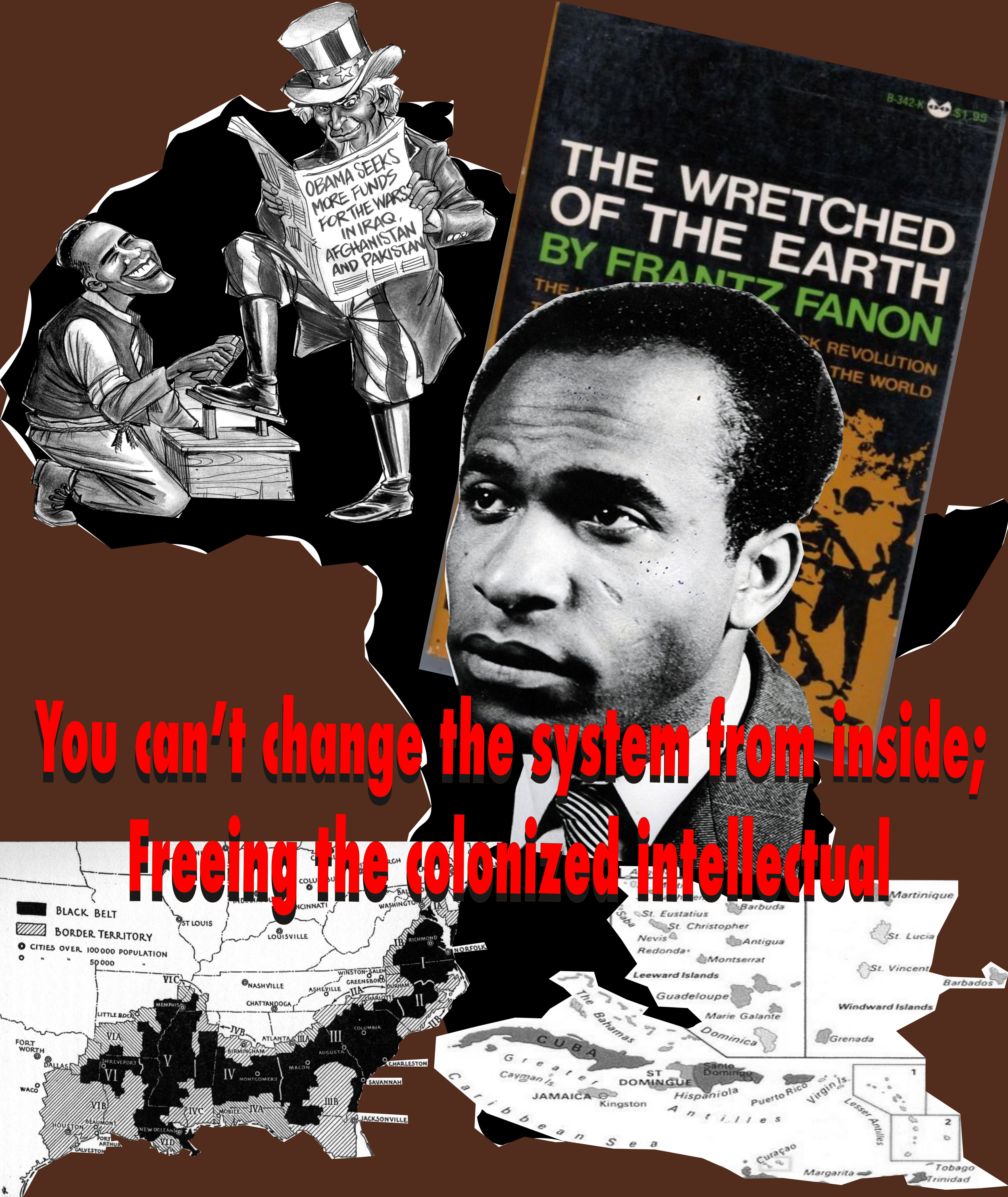
The Wretched of the Earth was written and published in 1961 by Frantz Fanon, months before he was sent to the United States from Algeria for life threatening treatment for pneumonia. He resisted earlier treatment because he did not want to be treated in “that country of lynchers.” When his health reached a worse level he was finally sent to the United States with a CIA agent issued to him by the US Embassy in Tunis.
They briefly stopped in France so Fanon could see Jean-Paul Sartre a last time, but he was too sick to speak. When he arrived to the U.S., the CIA detained him for ten days because of a “fake name;” days which doctors said were crucial to saving his health. He died in Bethesda, Maryland at Walter Reed Hospital with a CIA agent at his bedside on December 6th, 1961.
Fanon was born in the Caribbean French colony of Martinique where he was educated by colonial schools and teachers (excepting Aime Cesaire). He went to France where he studied psychiatry in the ivory tower and socialized with young French communists. Then because of his French citizenship, he compulsively joined the French army and was deployed in France’s war on Algerian independence. While there he recognized the contradictions and he defected from the French Army to join the revolting Algerian Liberation Front (FLN) as a psychiatrist.
He lived his life at every level of colonialism, born into it, assimilated into it, defended it, and then fought against it. His final text was not only a testament to those levels, but a guide for the colonized to defeat it themselves.
The Wretched of the Earth was a historically scientific, reverse engineering of colonialism, meant to serve as the “delineation of the backbone on which the decolonized society is organized,” according to Fanon on page 3 of the text.
In it, he defined colonialism as configuring a “compartmentalized world” of oppression (intersectional oppression), to keep the colonist in power. He sought to examine the major intersections to bring light to how colonialism achieved it’s “total domination of a land and people.”
He found that these intersections, contradictions, and compartments expose themselves the clearest when oriented against the peasantry of colonized societies, who formed what he called The Wretched of the Earth.
The following excerpt is from its last chapter, On National Culture, where Fanon fully defines the colonized intellectual as being the colonized member who betrays their people, and joins rank with the colonizer to assist in oppressing other colonized people.
In the first chapter Fanon mentions the colonized intellectual just 14 times, but in the fourth chapter he mentions it over 30 times and in just 25 pages. It is his most in-depth analysis of the colonized intellectual’s complex.
“Though historically limited the fact remains that the actions of the colonized intellectual do much to support and justify the action of the politicians. And it is true the attitude of the colonized intellectual sometimes takes on the aspect of a cult or religion.
But under closer analysis it clearly reflects he is only too aware that he is running the risk of severing the last remaining ties with his people. This stated belief in the existence of a national culture is in fact a burning, desperate return to anything.
In order to secure his salvation, in order to escape the supremacy of white culture the colonized intellectual feels the need to return to his unknown roots and lose himself, come what may, among his barbaric people. Because he feels he is becoming alienated, in other words the living focus of contradictions which risk becoming insurmountable, the colonized intellectual wrenches himself from the quagmire which threatens to suck him down, and determined to believe what he finds, he accepts and ratifies it with heart and soul.
He finds himself bound to answer for everything and for everyone. He not only becomes an advocate, he accepts being included with the others, and henceforth he can afford to laugh at his past cowardice.
This painful and harrowing wrench is, however, a necessity. Otherwise we will be faced with extremely serious psychoaffective mutilations: individuals without an anchorage, without borders, colorless, stateless, rootless, a body of angels.
And it will come as no surprise to hear some colonized intellectuals state: “Speaking as a Senegalese and a Frenchman. . . . Speaking as an Algerian and a Frenchman.” Stumbling over the need to assume two nationalities, two determinations, the intellectual who is Arab and French, or Nigerian and English, if he wants to be sincere with himself, chooses the negation of one of these two determinations.
Usually, unwilling or unable to choose, these intellectuals collect all the historical determinations which have conditioned them and place themselves in a thoroughly “universal perspective.” The reason being that the colonized intellectual has thrown himself headlong into Western culture.
Like adopted children who only stop investigating their new family environment once their psyche has formed a minimum core of reassurance, the colonized intellectual will endeavor to make European culture his own. Not content with knowing Rabelais or Diderot, Shakespeare or Edgar Allen Poe, he will stretch his mind until he identifies with them completely.
In some cases, however, at the very moment when the nationalist parties mobilize the people in the name of national independence, the colonized intellectual rejects his accomplishments, suddenly feeling them to be alienating.
But this is easier said than done.
The intellectual who has slipped into Western civilization through a cultural back door, who has managed to embody, or rather change bodies with, European civilization, will realize that the cultural model he would like to integrate for authenticity’s sake offers little in the way of figureheads capable of standing up to comparison with the many illustrious names in the civilization of the occupier.
History, of course, written by and for Westerners, may periodically enhance the image of certain episodes of the African past. But faced with his country’s present-day status, lucidly and “objectively” observing the reality of the continent he would like to claim as his own, the intellectual is terrified by the void, the mindlessness, and the savagery.
Yet he feels he must escape this white culture. He must look elsewhere, anywhere; for lack of a cultural stimulus comparable to the glorious panorama flaunted by the colonizer, the colonized intellectual frequently lapses into heated arguments and develops a psychology dominated by an exaggerated sensibility, sensitivity, and susceptibility. This movement of withdrawal, which first of all comes from a petitio principi* in his psychological mechanism and physiognomy, above all calls to mind a muscular reflex, a muscular contraction.
*Petitio Principi is latin for “Begging the Question” fallacy. This is a logical (argumentative) fallacy where the premise is assumed to be true without warrant. Or which in which what is to be proved is implicitly taken for granted.
The foregoing is sufficient to explain the style of the colonized intellectuals who make up their mind to assert this phase of liberating consciousness.
A jagged style, full of imagery, for the image is the drawbridge that lets out the unconscious forces into the surrounding meadows. An energetic style, alive with rhythms bursting with life. A colorful style too, bronzed, bathed in sunlight and harsh.
This style, which Westerners once found jarring, is not, as some would have it, a racial feature, but above all reflects a single-handed combat and reveals how necessary it is for the intellectual to inflict injury on himself, to actually bleed red blood and free himself from that part of his being already contaminated by the germs of decay.
A swift, painful combat where inevitably the muscle had to replace the concept.”
Overstanding | Reasoning | Building
The realization of a revolutionary culture from the depths of the colonized will inevitably, according to Fanon in this excerpt, bring about the blood of the colonized intellectual, who up until this point has only betrayed, sold out, and looked down on his fellow colonized.
This type of individual is universal for Africans struggling against colonialism across the diaspora. Africans today in Africa know the colonized intellectual as the business elite, as the politicians, and as the entertainers who all work together to protect the interests of the colonizer — The United States, Europe, or whoever else holds interest in the land.
Africans displaced by slavery and their descendants in the Caribbean know the colonized intellectuals similarly, but as the rich land-owning elites or families, along with the politicians, business elite, and entertainers who protect the interests of their economic exploiters — the United States, Europe, or whoever else holds interest in their tourism or exports.
Africans displaced by slavery and their descendants in the United States know the colonized intellectual all too well. They know them as
the Black Middle Class who turned it’s back on the colonized in the ghettoized communities in favor of white-adjacency
the Black Elite who hoard and exploit the wealth generated by the Black collective, who breadcrumb access to their hoarded resources, who reinforce a system of dependency in place of independence.
the Black politicians who’s very job necessitates their direct collaboration with the colonist’s project to decimate the colonized. Who contribute only to the worsening conditions both among the colonized ghettoes in their land and internationally.
and lastly the Black entertainers (rappers, actors, influencers) who lull the African colonized masses to sleep and deter them from revolution.
All of whom protect the interests of the United States.
To combat them? Fanon presents the step by step process for revolutionaries and militants to follow in each chapter of the book.
He argues, essentially, that revolutionaries and militant intellectuals must return to the depths of the Wretched of the Earth, or the peasantry, and engage in a genuine exchange of revolutionary theory and native culture. He argues that only this exchange of revolutionary theory/analysis and native culture will produce a revolutionary culture that can be properly built and destroyed as seen fit by the collective.
In this excerpt, he argues that such a culture will rip the colonized intellectuals from their positions and bring them back to the colonized. But that this process of return will require the colonized intellectual to sacrifice all that they know; because even the way that they think is representative of colonialism.
While colonized intellectuals in the United States may not seem to “embody” white culture at a surface level, it only takes Fanon’s look at compartmentalization to understand that what the colonized must do to their own culture, for it to fit into the colonizer’s acceptance, is no different than embodying white culture in the first place.
This disfigured culture — compatible with interests of colonialism and oppressive to the interests of the native — is what Fanon meant when he wrote “individuals without an anchorage, without borders, colorless, stateless, rootless, a body of angels.”
Something like today, where Africans in the United States have faced such a psychological assault that we have become widespread afflicted with protecting interests that are not our own yet are sold like they are.
We are unable to arrive at crucial revolutionary cultural baselines that are independent of the system that dominates us.
Fanon described the engagements between colonized individuals who have thrown themselves into the disfigured culture, and the collective who have realized a revolutionary culture, as producing “heated arguments” stemming from a totally illogical way of thinking.
In the period of decolonization, these colonized intellectuals produce what Fred Hampton called “answers that don’t answer, explanations that don’t explain, and conclusions that don’t conclude.”
At the end of the excerpt, Fanon asserts that the colonized intellectuals who have embedded themselves into the system, must abandon that system and bleed out that which the system has decayed, in order to return to their people.
To be colonized and to seek liberation by “working within the system” is a self-defeatist individual mission. No matter what. It is so because the colonist has already expected and set up the structure for you to “work within the system,” because it is after all their system. It operates on compartmentalization, therefore it creates a new compartment for anyone willing to accept a part of it — therefore all of it must be rejected.
As Fanon stated on page three of the text, Wretched of the Earth is meant to penetrate the compartments of colonialism, to delineate the backbone of a decolonized and anti-colonial society.
Fanon presents this text as the foundation for understanding colonialism, and naturally how to be anti-colonial. He presents this text as the foundation for which revolutionaries can build a new society based on his already historically grounded and scientific analysis of colonialism in the new age.
It is the only text called the anti-colonialists’ version of the Communist Manifesto.