
African Journalism for Empire or Liberation III: Hollywood Shuffle Film Analysis
Hollywood shuffle
Essentially, by converting the tradition of African storytelling into "labor," the colonists were effectively able to wage war against the African workers and turn many of them into agents against themselves and African people. This is the historical tendency of European colonial strategy, "psychological operation," a strategy espoused by the father of modern American public relations, Edward Bernays in his book Propaganda. Bernays, also the author of Crystallizing Public Opinion and Spin, was the architect of the battleground where war is not only waged to manipulate the American psyche -- but especially used to perpetually destroy and zombify the African psyche. Today, this can be seen on full display at media programs at Negro Universities’ journalism programs across the country. These Negro Universities contain mass populations of students studying “communications” but have no interest nor offerings to a radical intellectual tradition. The Negro University represents a glaring gap in the intellectual tradition of African media, where there are fewer than ever African journalist pursuing the fight against the colonialist apparatus. But because the African intellectual tradition of storytelling, Black journalism, started as an oppositional intellectual force to the media psychological warfare operation being waged on the African psyche, it is crucial that African journalists and media producers today return to their roots and fight the war on the battlefield.
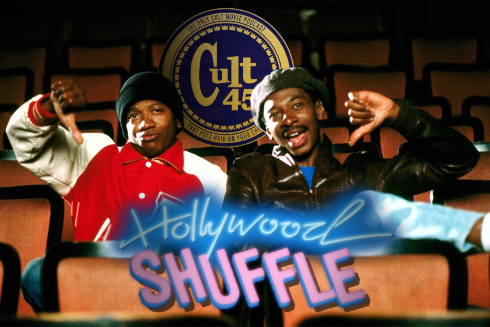
Townsend's film, Hollywood Shuffle, presented Black people as playing the role of community accountability and strength. The film followed Bobby Taylor, the main character played by Townsend, who is trying to break into the acting industry but is confronted with the obstacle of embodying and proliferating a stereotype. The plot of the story was largely anthological as the story of Bobby was more used as a vehicle for Townsend to wage war against the representation of Black people in film at large. Townsend waged his battle through numerous art styles indicating his knowledge and scholarship of film as an art, as well as how far superior his intellect was to that of the colonist. Throughout the film, Bobby's dignity is undermined by the colonists -- a direct assault on his psyche.
This is seen in the first scenes of the film during his audition where auditioning actors were told by their casting directors to act more "Black," or "Jive," both words used in condescending manners to degrade the Black actors. Of course the first projection of Bobby's subconscious also takes form at the audition through his lightskin "doppelganger" who tells him "this is bullshit. This is some more of the white man stereotyping the Black man. Yea brother. Only an Uncle Tom would do this shit." This is a revolutionary self-principle that Bobby is projecting or rather receiving from his African subconscious, and with Bobby's tendency to hallucinate/have visions, it is entirely possible that none of the lightskinned man's comments happened in real life. He certainly isn't acknowledged very much throughout the film, he truly only serves as the foil to Bobby which again connects him to Bobby's consciousness and character.
That subconscious is being exalted out of Bobby and striking back at the system, creating a situation where Bobby is subconsciously striking back at the system. This is a film technique often used by writers and directors, where the main character's actions are projected onto another character; or where another character represents the thoughts of the main character. Townsend, in this manner, used characterization as a means of validating and amplifying the dissenting voice that Black people should have when they are about to betray their community's interests.
The inner revolutionary voice within African people had been craftfully forced to sleep by drowning it in media, police, and drugs in all the years leading up to Townsend's film, and Townsend's film was a jolt at a time when nobody pointed out the stereotypes placed on Black characters. What I thought was one of the most creative depictions of these stereotypes and their reception by the Black community -- indicating that social and psychological control was indeed taking place through film -- was the section of the film where the two young Black men were critiquing the films after sneaking into the movie theater. The clips they critiqued were three movies without mostly Black casts and one movie with a mostly Black cast.
The three movies without mostly Black casts, they either disagreed on or agreed on the bad quality of. The only movie where there was unanimous agreement that the movie was "good," was the movie depicting Black people as stereotypes. The critics themselves acknowledge this fact saying "The last movie we really enjoyed. It was full of stereotypes but it was well directed. And we thought the combining of the zombie pimps and the street hoes was brilliant." Here, Townsend is using the critics to make a statement about the general state of Black film: that out of the mere starvation for dignified and respectful representation, Black audiences are left to accept and consume images that are "full of stereotypes." Though this wasn't a "strike" back at the hegemonic system of film and mass media, it served as the analytical underpinnings for what Townsend was attempting to do in his film -- a fight to claim the narratives of Africans.
In that fight to claim the narratives of Africans, Townsend posited his character's grandmother as the next evolution of his subconsciousness, but this time instead of it being his doppelganger, it comes directly out of his own ilk. Townsend's grandmother symbolized that Bobby's ancestry was also working against his interests of upward mobility and class abandonment by becoming an actor who would sell out his people. First out of her own volition when Bobby is leaving for his audition, she said
"Now don't get me wrong. I am happy for Bobby, but I don't want no grandson of mine out there trying to act like a street hustler. Black folks got enough negative images. Got my grandson out there adding to that mindless bullshit out there. Every time you look at TV, always somebody acting like a pimp or some tired ass nigga. Kids don't need to see that stuff. Acting like they think it's cool to be in a gang."
Immediately following her protest of Bobby's participation in the film, was Bobby's mom's attempt to defend Bobby by saying that although it was morally corrupt, it was still work. His grandmother, the eventual representative of his underlying revolutionary energy, snapped back at his mom to say "there's work at the post office too." This was an autonomous expression of opposition by Bobby's grandmother, something Townsend found crucial to include in the film because when she reappears later at the moment of Bobby's decision between to commit class suicide by abandoning the film or to commit community homicide by continuing the film, she's his driving trigger to quit the film.
The latter, class suicide, is what made the film a revolutionary film and a strike back at the system of colonialism as it operates through mass media psychological warfare and thus film as an extension of the media. In The Wretched of the Earth, Frantz Fanon described the process of class suicide for the colonized intellectual as being a process where
"because he feels he is becoming alienated, in other words the living focus of contradictions which risk becoming insurmountable, the colonized intellectual wrenches himself from the quagmire which threatens to suck him down, and determined to believe what he finds, he accepts and ratifies it with heart and soul. He finds himself bound to answer for everything and for everyone. He not only becomes an advocate, he accepts being included with the others, and henceforth he can afford to laugh at his past cowardice," (Fanon, 155).
What Fanon referred to here was the concept of cultural production under the revolutionary phase and how the culture of the people will determine the validity of a community member or intellectual. In this case, Bobby represents the "colonized" intellectual who is threatening to betray and harm his community depending on the decision he makes about partaking in the film. Townsend seemed to understand the very phenomenon that Fanon was explaining, and he depicted it just as explicitly as it was written.
After Bobby's doppelganger -- Townsend's most explicit depiction of Bobby's double consciousness -- tells him that the NAACP was planning to picket the film, Bobby has a vision of his alienation from his community. Those visions are depicted by Townsend as a compilation of various members of Bobby's community like an NAACP president, his grandmother, his coworkers, his spouse, and even his little brother, who all expressed that they were exiling him from the community. In the film, the NAACP president Jamal Harris said
"We felt we had to put our foot down, by making Bobby Taylor an example. We feel that Black actors should not have to accept these stereotype roles such as crying slaves, tar babies, jungle bunnies. And I say that as long as Black actors, play these roles they'll never play the rambos till they stop playing the sambos."
What followed was a similar barrage of community members alienating Bobby. When a reporter asked his brother how he felt, he said "He's not my brother, he's just a guy that lives in the same house he's a renter." His grandmother echoed saying, "I don't have a grandson anymore. I really don't. And what am I gonna do about it, I'll tell you what I'm gonna do about I am going to write me a book about it." A mother from the community said "I'm so sick of Bobby Taylor comin around influencing the kids. Got my kid grabbin his wallet and shining shoes." Even his spouse contributed to the alienation by saying "I'm proud of my race. And no, I don't like it. I really thought he was gonna make the right choice but obviously he didn't. I didn't know he was going to act like some sort of picaninny."
All of these paint the very picture that Fanon explained of the culture of the colonized African -- alienation will occur when the colonized intellectual breaks rank in favor of the colonists. Sure enough, it was Bobby's envisioning of himself being alienated that prevented him from finishing the film, and he decides to express this at the final moment when he's told to act more "jive" or "Black," and he looks at his brother and grandmother before announcing his departure from the film in a huge upset to the director.
Townsend ending the film with Bobby abandoning the capitalist "okie doke" of selling out for capital, is a revolutionary message that communicates to Black audiences that your principle and community are more important than fame/stardom. This revolutionary message is hammered by Bobby's final quote while working at the Post Office as an actor for its commercial: "I deliver people's dreams, and more importantly I have the respect and admiration of the entire community. And that makes me proud."
Townsend's film is the epitomization of African revolutionary theory at multiple different levels whether it's the double consciousness out of the pages of W.E.B. DuBois, the revolutionary suicide out of Huey P. Newton, or the colonized intellectual's class/identity suicide out of Frantz Fanon. His film wielded theory merged with humor as the final blow to the behemoth of Blaxploitation which had been used the decade preceding as an arm to ensure and enforce European colonialism at a psychological and sociological level. Townsend's work is an effort towards the end of colonialism, and just as Frantz Fanon said, "to work means to work towards the death of the colonist."