
African Journalism for Empire or Liberation II: Martin Delany and the Debate About Africa.
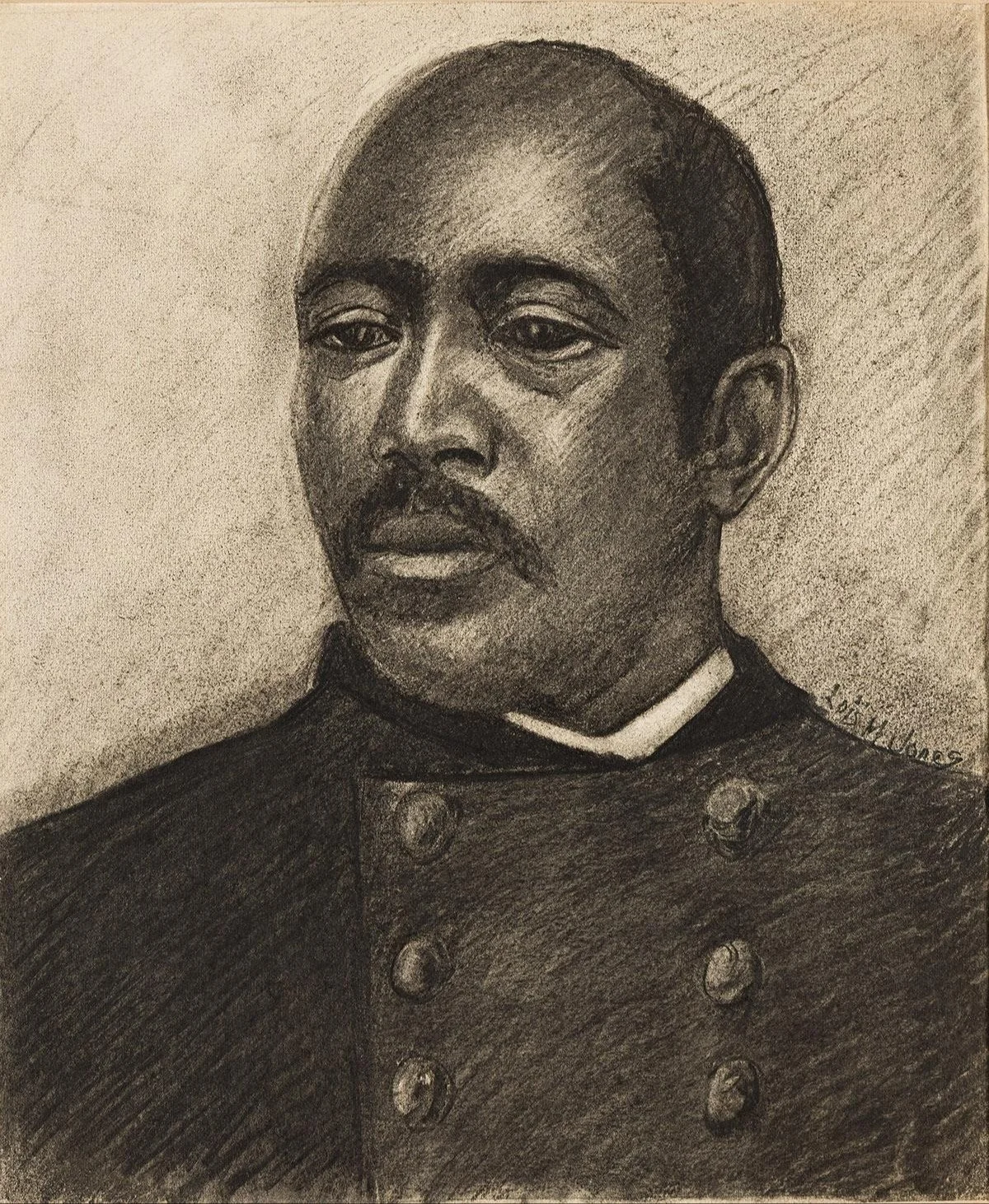
Martin Delany Illustration via Mutualart.com
The story and journey of radical African thought in the United States is directly tied to the means of communication by which Africans used to communicate amongst each other and to the world. Africans displaced in the United States used the communication medium of journalism to enshrine their early radical ideological principles. That journalistic path began very explicitly radical and remained close to the root of its radical forefathers in its early stages, so much so, that even the immediate offspring publications of the first African-owned publication -- Freedom's Journal -- were experimenting with the same status-quo destabilizing concept: Africans in the U.S. rejecting an American identity and identifying as Africans.
Martin Delany was one of the first luminaries to immediately succeed Samuel Cornish and John Russwurm's exploration of the concept of African identification and American rejection. Delany was born in West Virginia in 1812 to a free mother and an enslaved father (Butler). He had a relatively privileged life and was educated as his mother could afford to move them to Pennsylvania in 1822 to avoid freeperson persecution. After his period of education, Delany met Frederick Douglass and launched the North Star publication with him, despite their eventually conflicting views over the destiny of Africans in the United States.
Douglass' position was notoriously associated with staying in the United States and Africans developing an American identity. Delany's position, however, came out of the tradition of John Russwurm which was an African-centered tradition later to be known as Pan-Africanism; his position was that Africans in the United States could only be liberated if they fully identified as Africans and united with Africa in destiny and mission. Delany has stood out as one of the earliest and sharpest luminaries of both the context of his time and of specifically the conversation around the relationship between the identity of Africans in the United States and liberation.
Delany published his first work, a pamphlet called The Condition, Elevation, Emigration, and Destiny of the Colored People of the United States, Politically Considered, in 1852, just two years after he was dismissed from his medical education because of petitions from white students against his being there. In that debut work, Delany militantly expatiated on the relationship between economic-societal class status and racial/ethnic status writing,
"That there have been in all ages and in all countries, in every quarter of the habitable globe, especially among those nations laying the greatest claim to civilization and enlightenment, classes of people who have been deprived of equal privileges, political, religious and social, cannot be denied, and that this deprivation on the part of the ruling classes is cruel and unjust, is also equally true," (Delany).
His sentiments here directly coexisted with the ideological production occurring halfway across the world in Germany through Karl Marx who was born in 1818 and died in 1883. The two were six years apart, but were arriving and establishing the opuses of the thought traditions of either of their respective lineages. Understanding Delany's journalism at this time sets the precedent for how African political thought should and can be understood in relation to European political thought. Both were, in many ways, arriving at the same conclusions through different means of communication -- Delany through his pamphlet journalism and Marx through essay and bookwriting. Delany expounded further on the idea of classes in ancient Europe by drawing the connection between that reality and the reality of Africans who'd been displaced in the United States. He wrote that,
"Wherever there is arbitrary rule, there must be necessity, on the part of the dominant classes, superiority be assumed. To assume superiority, is to deny the equality of others, and to deny their equality, is to premise their incapacity for self-government,"(Delany). And "Such then is the condition of various classes in Europe; yes, nations, for centuries within nations, even without the hope of redemption among those who oppress them. And however unfavorable their condition, there is none more so than that of the colored people of the United States," (Delany).
Here, Delany has identified the fundamental contradiction of the "African-American" conundrum, or rather the paradox of Africans attempting to identify as Americans. That fundamental contradiction is that the African reality is held under "arbitrary rule" -- European Rule -- and as long as Africans are under that rule then they will be inferior in a manner severely worse than any inferiority that preceded the African one, in European class structures.
Delany was dealing with that fundamental contradiction at a time when attitudes against the institution of slavery in the United States were mounting and the Negro Question was finally being taken more seriously. It was clear that Delany was in a position where he recognized that the voice of Africans was going to be necessary for the determination of Africans in a post-slavery world which led him to Frederick Douglass and the North Star. By placing his sentiments at the first chapter of his pamphlet, it was clear that Delany understood that if his reader were to understand any of his understanding, they must understand the fundamental contradiction.
In a global context, Delany can be best understood as landing among the post-enlightenment intellectuals like Karl Marx. His predictions and analysis for what was to come was just as sharp and shaped the path for Pan-Africanism to develop for the subsequent decades to come.
After Delany developed his initial argument in the first section of his pamphlet, he went on to encourage Africans in the United States to develop their understanding beyond the conventional American identity. Delany began to espouse a nation-within-a-nation mentality that called for the repatriation of Africans to Africa and the rejection of an American colonial yoke. His understanding of Africans being a nation-within-a-nation and requiring a different solution than the oppressed peoples of before, was an understanding that largely shaped the way Africans were understood and seen by both themselves and by the larger United States colonial apparatus.
Delany's sword cut both ways when he identified that the African "race is to be redeemed; it is a great and glorious work, and we are the instrumentalities by which it is to be done. But we must go from among our oppressors; it never can be done by staying among them," (Delany). It cut both ways because it enshrined both for Africans and for American colonialism that Africans would never be a part of the American apparatus -- but his work outlined a way for Africans under the United States' arbitrary rule to usurp that rule: repatriation. His solution to return to Africa forced Africans in the United States to confront their identity as Africans or Americans.
In regard to longevity, however, Delany's work tilled the soil for Pan-Africanism by ripening the land for the thought of later luminaries like Marcus Garvey, Cyril Briggs, and W.E.B. DuBois. Delany coined the term "Africa for the Africans," a slogan later popularized and promoted by Marcus Garvey who effectively sowed the seeds for cultural and aesthetic Pan-Africanism while Delany established its ideological roots in class and fundamental contradictions. Simultaneously, as class understandings were developing in the United States in the subsequent decades after Delany, his work can still be seen ruminating throughout the works of writers like Harry Haywood.
Harry Haywood, a member of the CPUSA, was credited with understanding Africans as a nation of workers within a nation, and therefore required a different type of liberation than the traditional worker. Holistically, Delany was a significant force in the shaping of the national conversation around the Negro Question -- or how Africans were to be understood -- and it is ever clear that he sowed the seeds for Pan-Africanism to develop in the method that it did.
Works Cited
Britannica. (2019). Martin Delany | Biography & Facts | Britannica. In Encyclopædia Britannica. https://www.britannica.com/biography/Martin-R-Delany
Butler, G., & Butler, G. (2007, March 4). Martin Robison Delany (1812-1885). BlackPast.org. https://blackpast.org/african-american-history/delany-major-martin-robison-1812-1885/
Feuer, L. S. (2018). Karl Marx. In Encyclopædia Britannica. https://www.britannica.com/biography/Karl-Marx
Delany. M. (1852). The Condition, Elevation, Emigration, and Destiny of the Colored People of the United States, Politically Considered.
https://www.gutenberg.org/files/17154/17154-h/17154-h.htm