
African Journalism for Empire or Liberation?
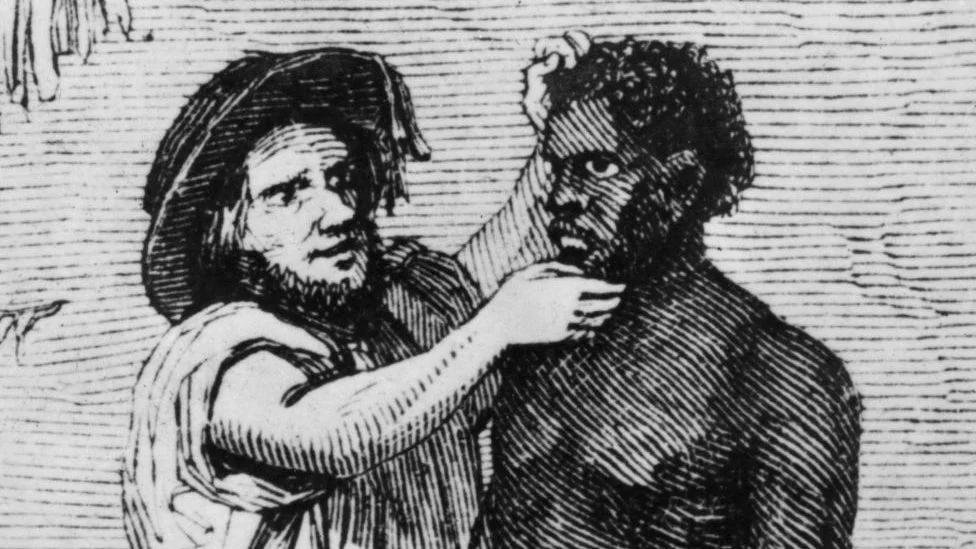
From: "Mon arrière-grand-père nigérian a vendu des esclaves" — My Nigerian Great Grandfather Sold Slaves
It is the job of African journalists, and by extension African media professionals, to explicitly abandon and denounce the Western journalism institution and all of its antecedents. "The nationalist leaders know that international opinion is forged solely by the Western press. When a Western journalist interviews us, however, it is seldom done to render us service,” Frantz Fanon wrote in Wretched of the Earth. The classic Western journalism institution is made up by legacy publications like The New York Times, Washington Post, and Baltimore Sun who all have contributed and continued the intellectual traditions of European colonialism through their tacit support and justification of the settler colonial project that is the United States. The intellectual origins of European colonialism are explained by Mumia Abu Jamal and Stephen Vittoria in their “Dreaming of Empire”
This Western journalism institution, like the colonial-capitalist apparatus it hails from, works to justify and sustain the existence of the colonial project and will do so by any means necessary. The African journalist must reject this int
whose precedent is followed by new white publications,
sells to the African journalist a path of upward social mobility and bourgeois aspirations in exchange for the African journalist becoming a mouthpiece
and submit to the will of the people to tell and record the people's stories. The historical tradition of African media production stretches far beyond journalism and boils down to a more African intellectual tradition: storytelling. Storytelling is an intellectual tradition because it captures the intellectual productions of Africa and her people.
Journalism is storytelling universally, but for Africans storytelling carries greater meaning and thus the African journalist carries the responsibility of continuing that tradition. The colonialist regime, that African journalists have been forced to develop under over the last 198 years since the Freedom's Journal, has since proved to be hell-bent on the suppression and disintegration of that intellectual tradition and manipulate/pervert it in interest of colonialism. Ultimately, that manipulation and perversion of our intellectual storytelling traditions, takes the same form of Africans being used against their people on the plantation.
Essentially, by turning our tradition into "labor," they were effectively able to wage war against the workers and turn many of them into agents against themselves and their people. This is the historical tendency of European colonial strategy, "psychological operation," a strategy espoused by the father of modern American public relations, Edward Bernays in his book Propaganda. Bernays, also the author of Crystallizing Public Opinion and Spin, was the architect of the battleground where war is not only waged to manipulate the American psyche -- but especially used to perpetually destroy and zombify the African psyche. The African intellectual tradition of storytelling, Black journalism, started as an oppositional intellectual force to the media psychological warfare operation being waged on the African psyche.
The three essays I produced for Howard University's Multicultural Media History course taught by Bro. Sam P.K. Collins represents my attempt to align an academia-structured curriculum with a snapshot of the modern African intellectual storytelling tradition a.k.a. Black journalism. Each essay aims to be in conversation with the former either affirmatively or negatively with the central goal to spur the call for African journalists to abandon and denounce the journalism industry in exchange for plunging themselves into community. The series is called: "African Journalism for Empire or Liberation?"
The first essay represents the initial materialization of the African intellectual storytelling tradition by drawing connections between the obstacles faced in the production of Freedom's Journal, the first Black newspaper, and the obstacles faced in the production of Black news subsequently.
The second essay posits Martin Delany as the equivalent of a Karl Marx level thinker for African people, as he was arriving at many of the same conclusions about class and class dynamics under capitalism as Karl Marx was during his time. That parallel theoretical production is monumental for the African intellectual tradition, because Delany recorded his theories and published them making them accessible more than a century later. That tradition of storytelling is important because it sets the context by which we are produced and by which we are to work as African journalists. That context should dictate us to be tenaciously rejecting the colonial apparatus wherever it presents itself.
The third essay attempts to, firstly, present the necessary context to understand the historical production and design of the media psychological battlefield after Delany and Douglass' era. In the early 1900s, particularly prior to and during the era of the second industrial revolution of the 1920s. That is when the United States officially co-conspirated with the father of modern Public Relations to adopt media as a weapon in the arsenal for public control. In line with the intellectual production of Europeans -- dating back to Machiavelli who argued public control in his book The Leviathan -- Bernays helped to create the battlefield for which many Africans subsequently found themselves fighting for the enemy's side after the civil rights movement. The third essay then attempts to, secondly, shift to focus on Robert Townsend's Hollywood Shuffle. The preamble is necessary particularly to understand that Townsend's Hollywood Shuffle was the first Black film to so blatantly callout, depict, and reject the stereotypes proliferated by mainstream media about African people in the United States. The final call to action in his film aligns with the final call to action of this series: African journalists and African storytellers must abandon and denounce the exploitative social upward mobility path, and instead ground themselves in the African tradition of reporting from the community. Townsend, at the end of his film, denounces and abandons the film industry after refusing to play a role depicting African people negatively and thus disappointing his community -- he then takes a significantly lower paying job and says serving the community is better than being rich.
He could not have been more right. African storytelling is African Journalism. African Journalism for Empire or Liberation?