
“No guardrails” against gentrification in Baltimore
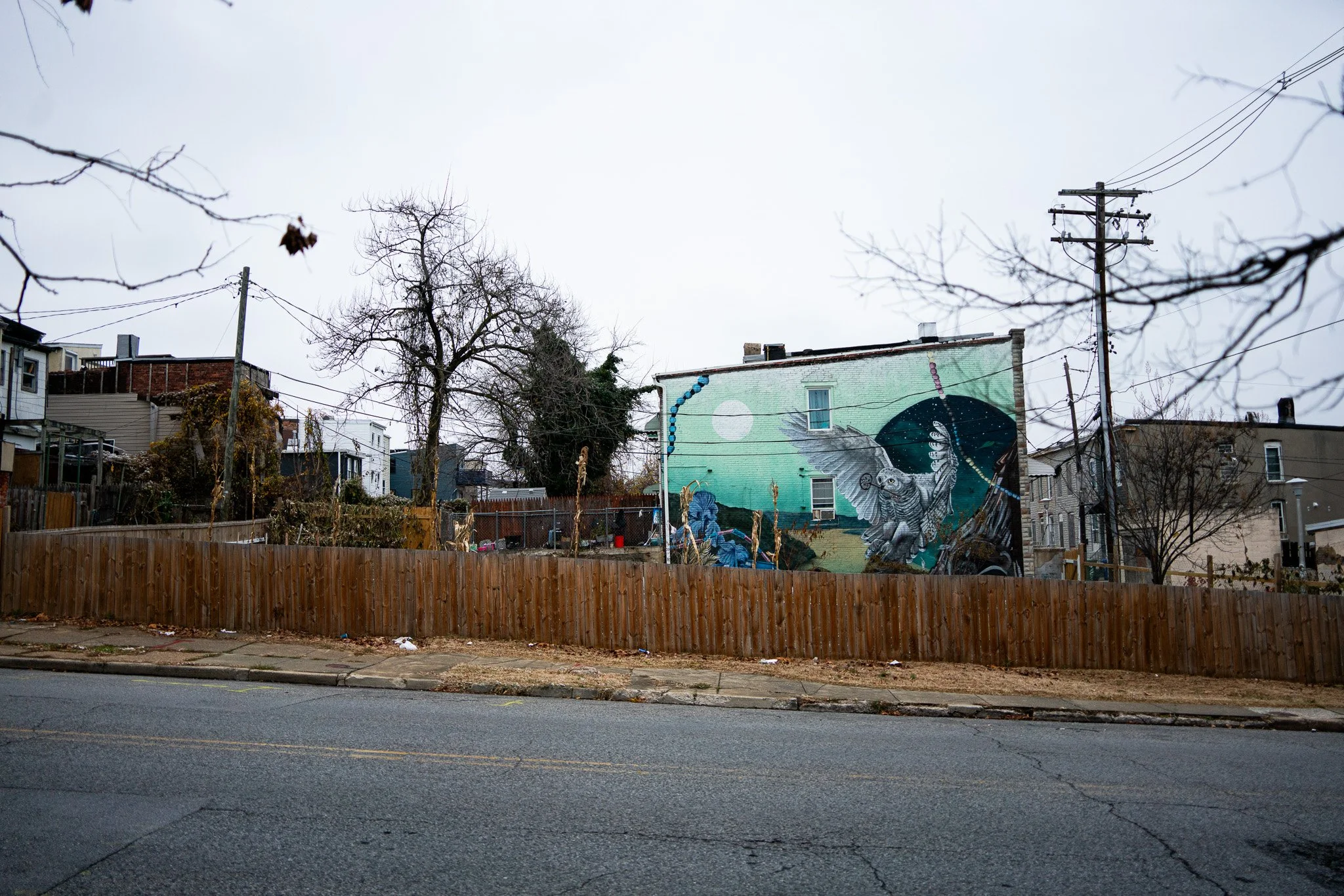
Properties on Ramsay Street. Photo by Elijah Pittman
The Fixed Pricing Program might expose the city government’s unpreparedness for urban renewal.
Darius Gaymon was trying to build a facility for homeless people in West Baltimore's Mount Clare neighborhood through Repurposed Resources, an extension of his already successful D.C.-based non profit, One More Plate.
He heard about Baltimore's Fixed Pricing Program, a city initiative aimed at quickly selling vacant properties, after a friend recommended it to him as an opportunity to establish roots in the city.
Then he worked with his former realtor, Dominique Lamb, to apply for a single property during the program's April 2024 "resident-only" phase. They exchanged emails with the city for a year chasing "shifting" requirements to be considered eligible for the property.
"It didn't seem that they had a clear process for him to follow," Lamb said. "So I don't believe that whatever their goal was, I don't believe it aligned with truly making housing more affordable or making more Baltimoreans, homeowners."
The program itself is a part of an initiative by the city to tackle its vacant housing challenges, of which there are over 12,500 across the city. It basically worked by setting a fixed, low price for individuals, community land trusts, non-profits, and developers to buy and rehabilitate vacant properties to bring them back into "productive" condition according to Baltimore City's Department of Housing and Community Development (DHCD).
The program claimed to sell properties quickly, within 90 days and to prioritize residents of the city, but a report from Maryland Matters demonstrated that the city might not be prioritizing residents, because only 11 of over 400 applicants qualified for the program.
"We aren’t going to close the door on others who have the resources to bring these properties back in productive use, which could be developers that want to develop multiple properties,” said Tammy Hawley, the DHCD communications director. “Maybe they want to rent, maybe they want to sell. You know, every situation is different.”
After Gaymon applied to the program, the city responded to his application telling him the property was actually reserved to be sold as a batch of four properties, for a "block by block" transformation. Gaymon saw this as an opportunity to bring in his nonprofit, Repurposed Resources, an extension of his already successful D.C.-based non profit, One More Plate.
Ultimately, he was still denied.
But what public records acquired through a Maryland Public Information Act (MPIA) request filed by Elijah Pittman in 2025 revealed, was that the city actually did accept applications from non-city residents during the first phase, and that Gaymon's application was ultimately denied in favor of an application from a person based over 400 miles away from Baltimore in Massachusetts.
So effectively, the city told Gaymon several things for nearly a year about how he could meet the qualifications, and as he met them the requirements shifted until Matt Desantis, the Director of Neighborhood Development and Outreach, shut his application down in April 2025.
"For all of these reasons I’m leaning towards advancing a recommendation to my Assistant Commissioner that this Fixed Pricing Program application be denied," Desantis said in a 2025 email to Gaymon.
Desantis said this was because he'd rather hold the lots for another set of three adjacent lots that the city was pursuing, an entirely new reason that Darius was not initially made aware of.
"Even if you were able to provide evidence of a site development plan that required no variances and significantly more robust financing, the Assistant Commissioner might still prefer that we hold these four lots to be assembled with the three adjacent ones we are currently pursuing," he wrote.
This is alarming because Baltimore's vacant housing crisis has recently become characterized by outside forces taking advantage of the city's programs targeted at handling its vacant housing crisis. Recently, the Baltimore Sun reported the delays from the city permit office.
In October, a Baltimore Banner article traced how private equity and Wall Street backed financiers were creating a potential foreclosure crisis in the city.
Last year, an article from Maryland Matters reported that only 11 out of 459 Baltimore City residents who applied were approved for the program. Now, a year later, the program's success is still impossible to measure, but Gaymon's story could reflect a larger phenomenon happening in the city -- commercial developers being chosen by the city over individual homeowners.
Commercial developers being chosen over individual homeowners is dangerous because commercial developers have long signaled gentrification for Black communities.
But let's rewind. The Fixed Pricing Program itself was launched in April 2024 by DHCD as part of a multipronged effort to tackle Baltimore's vacant housing crisis, of which there are over 13,000 across the city. The program works by selling city-owned/city-acquired vacant buildings and lots to individual homeowners, non-profits, community land trusts, and for-profit developers, at a varying fixed price based on the status of the applicant, with significantly higher prices for for-profit developers and large non-profits.
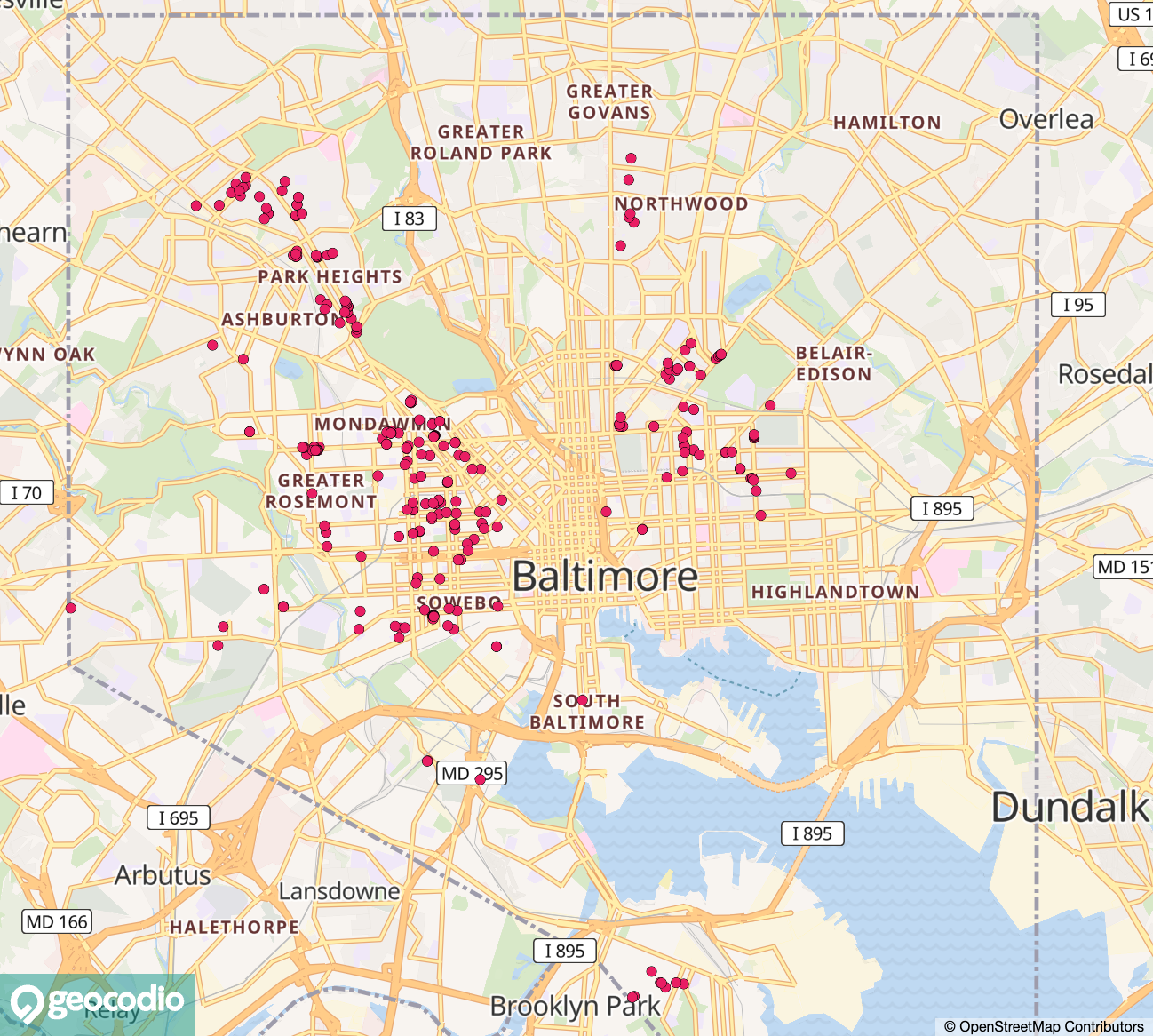
All of the houses approved and awarded in the program were concentrated in Baltimore's Black communities, which, when mapped out (right), follow the outline of the Black Butterfly. The Black Butterfly was coined by academic Lawrence T. Brown to describe the shape that Baltimore's Black population makes on a map
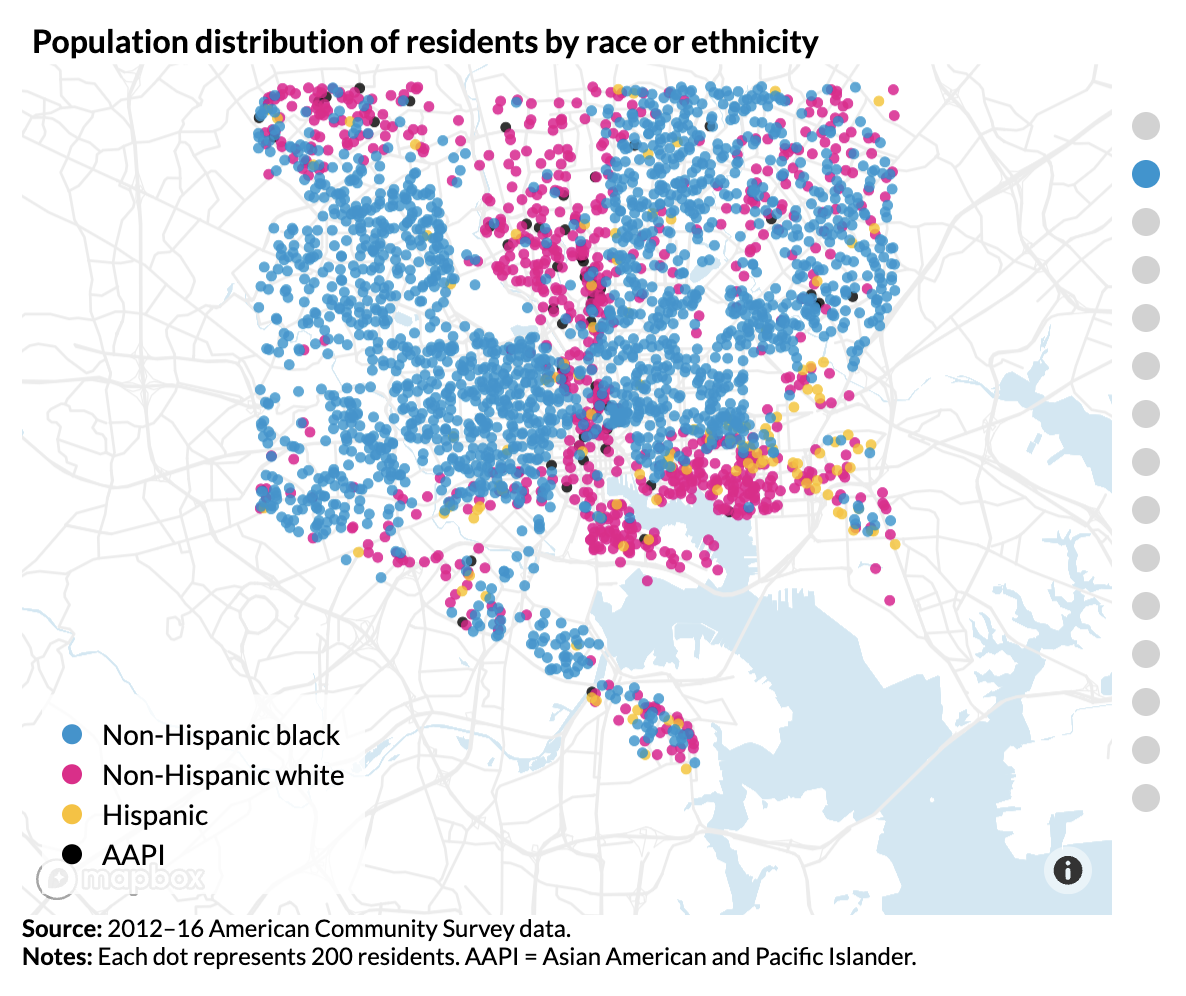
The Black community came to make such a concentrated shape in the East and West wings of the city after several major housing projects, including Murphy and Lafayette Homes, were demolished. The projects were demolished in 1999 and housed many of the city's poor and Black communities. The projects' destruction cleared Black people away from the city's "White L,' by pushing people away from the center and south east parts of the city.
The city relocated residents of Murphy Homes, which held 758 apartments, and dispersed them across West Baltimore, according to Capital News Service. Heritage Crossing was one of those locations, but it has less than 35% of apartments that Murphy had.
That forced Black people to go further into West Baltimore's neighborhoods, like Sandtown-Winchester.
"Sandtown, in terms of vacancies and poverty concentration, gets worse. And then the police brutality came on," said Derek Hyra, professor of Public Administration and Policy at American University explained.
Hyra wrote a book called Slow and Sudden Violence that tied together the uprisings of Ferguson and Baltimore to understand the historical urban development forces that produced such reactive uprisings in these cities.
"The slow violence is the violence of knocking down somebody's home and displacing them, and then the sudden violence is violence of the police and the policing of the concentrated poverty," he said.
Under the Fixed Pricing Program, no housing projects or apartment complexes are being destroyed, but instead, vacant homes are being sold in the very communities Black Baltimore was pushed to after the destruction of major housing projects.
"The history is that there are policies that have placed us where we live. And so the colonizing effect is almost like when a Native American is placed on a reservation," said Coleman Jordan, professor of architecture at Morgan State professor.
He explained that the destruction of public housing projects helped produce the communities we see today in Baltimore.
"Yes, things have changed, but the residue of redlining, the residue of placement, is still in existence. So I think that's where we have our dilapidated communities."
With such a high concentration of homes being sold in West Baltimore particularly, a place where the "colonizing effect" of forced placement was most popular, what the city plans to do to protect the communities is important to prevent gentrification.
"I would think that what Baltimore should try to do, is if they're going to continue with this policy, they've got to be careful in the areas that are feeling the forces of gentrification already," Hyra explained.
Howard journalism revealed, however, that the city might not be exercising caution. When asked about several data errors within the records received, the city refused to answer certain questions. One of the errors were 35 missing applicant names, to which the department's director of communications, Tammy Hawley, said there were only 19 that had since been fixed.
Another error was the inconsistencies between the data received and the city's published data of the program, a website which has since been taken down by the city and reads a "403 Forbidden" code when accessed.
The city also completely ignored questions about 1420 Ramsay St, the single property sold to Massachusetts' Tsoutsoplides, that Gaymon was told would need to be developed as a complete bundle.
According to the Maryland Matters article, Hawley said of the first program that the city wasn't going to close the doors on applicants who have the "resources" to bring properties alive. She said these could be developers who want to develop multiple properties.
This same sentiment was expressed by Baltimore's 7th district city council member, John Bullock. Bullock's district ranks second to the 9th district in most homes sold under the Fixed Pricing program. Of the more than 250 homes awarded in the city, nearly half were found in the 7th and 9th district, which are in West Baltimore.
"Is gentrification a good or a bad thing? Some say good, some say bad, some say they don't know. It depends on your perspective if you're an owner or a renter," Bullock said. "But the reality is that we need to get these properties into productive use."
He explained that his personal disposition is for "development without displacement," where the existing community isn't uprooted but is instead supported as development occurs. He explained that a part of this strategy is a "whole Block strategy."
"Can we develop the whole block? It tends to have a more beneficial impact than just doing one property here and one property there," he explained.
This makes sense for why Gaymon was told that he would need to develop the entire bundle of properties located on Ramsay St. But what doesn't make sense is why the city then chose to abandon a "whole block" solution and award the property to a person based hundreds of miles away. Ramsay St is located in Bullock's district, and when asked about the situation he said,
"I'd be concerned about that. I'm not encouraged by that. I would rather the one person who's local who can do one property, than have somebody from out of town who can do one property," Bullock said.
Bullock's counterpart, 9th district councilman James Torrence, has also been outspoken about this program and the housing bills recently passed by the city council, according to the Baltimore Banner. Those bills would allow people to build closer to their property lines and get rid of off-street parking requirements.
Torrence could not be reached for comment but he called these density bills an opening for gentrification in the Banner article.
“We have no guardrails in place,” Torrence said. “When Black people leave this city, I want to make sure on this council record that I told you so," he said.
Bullock expressed the same sentiment to Howard Journalism as Torrence did to the Banner.
"We need to have better guardrails," Bullock said.